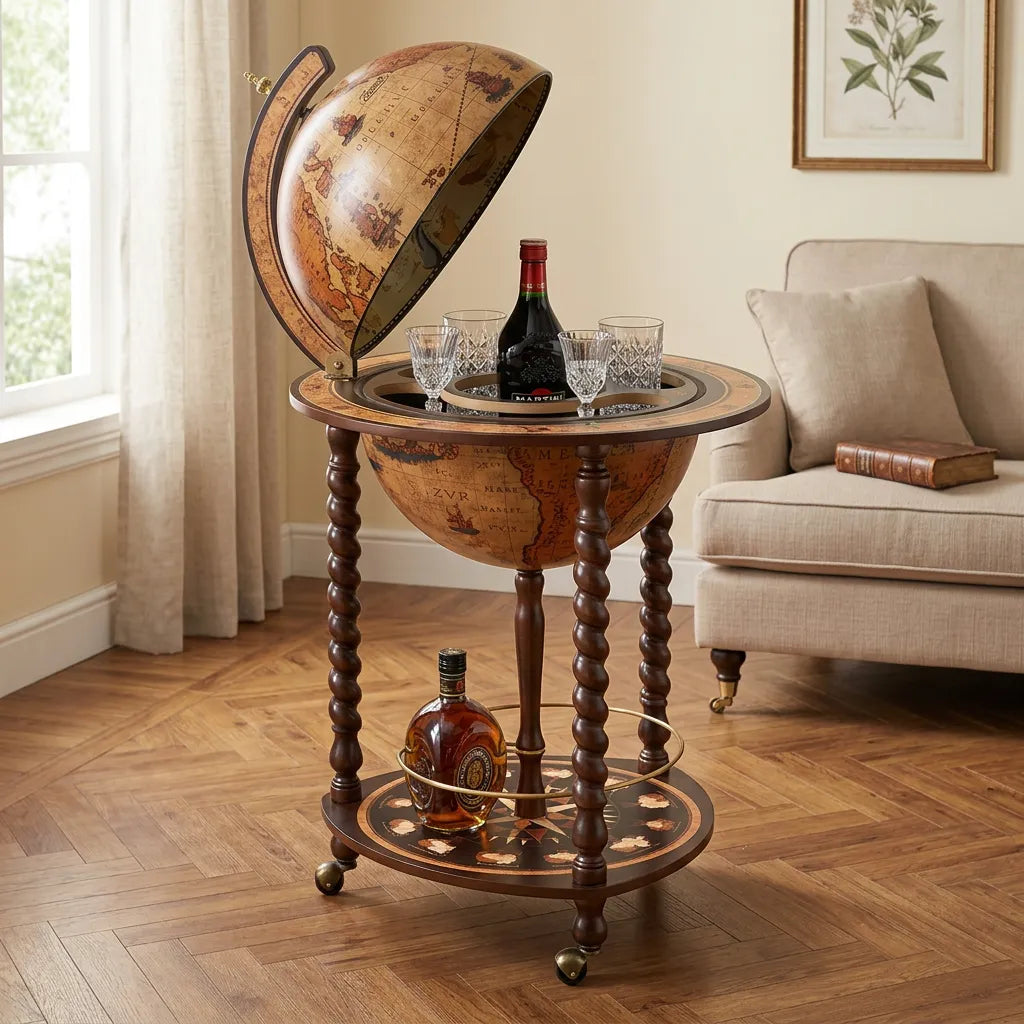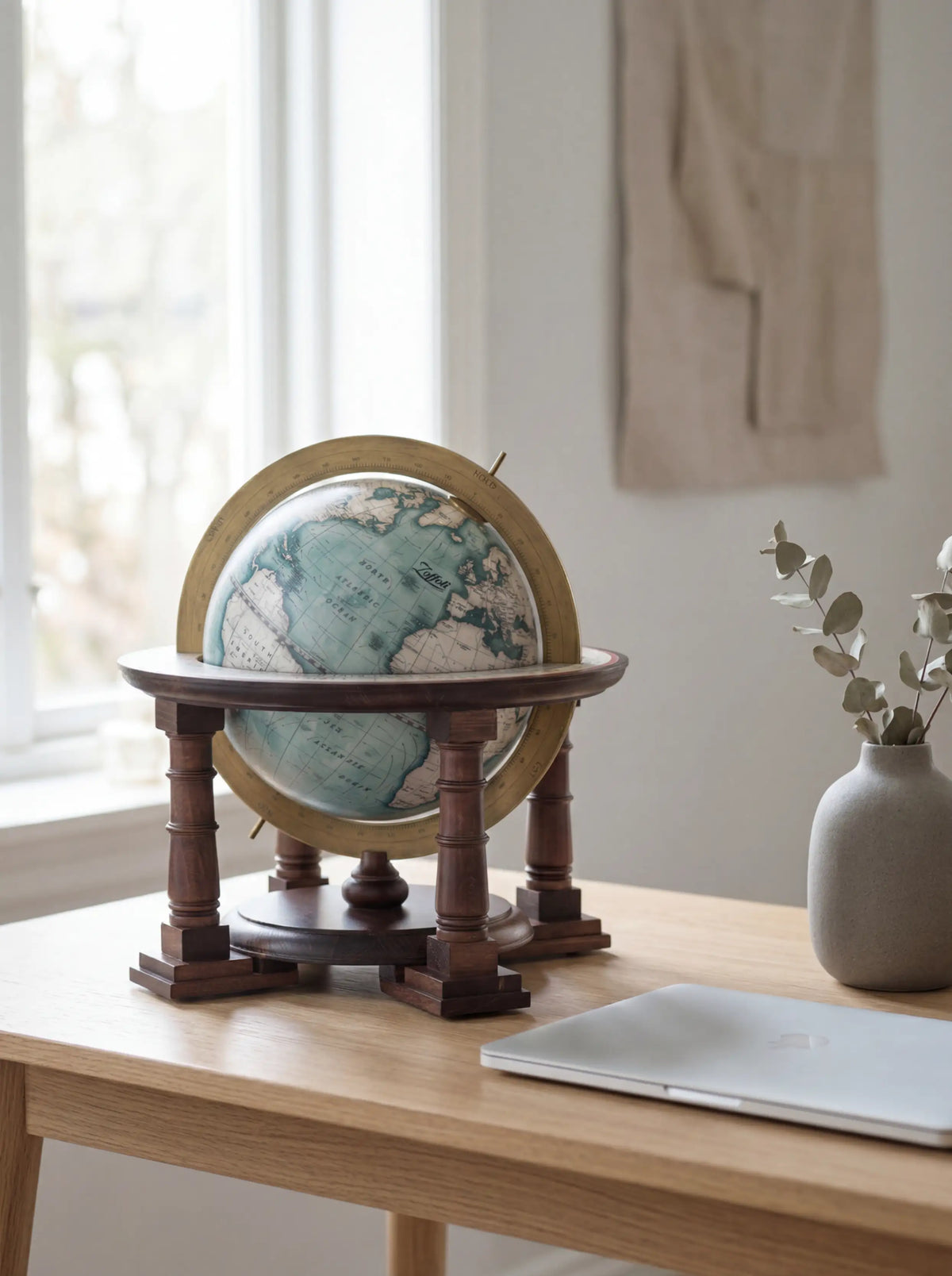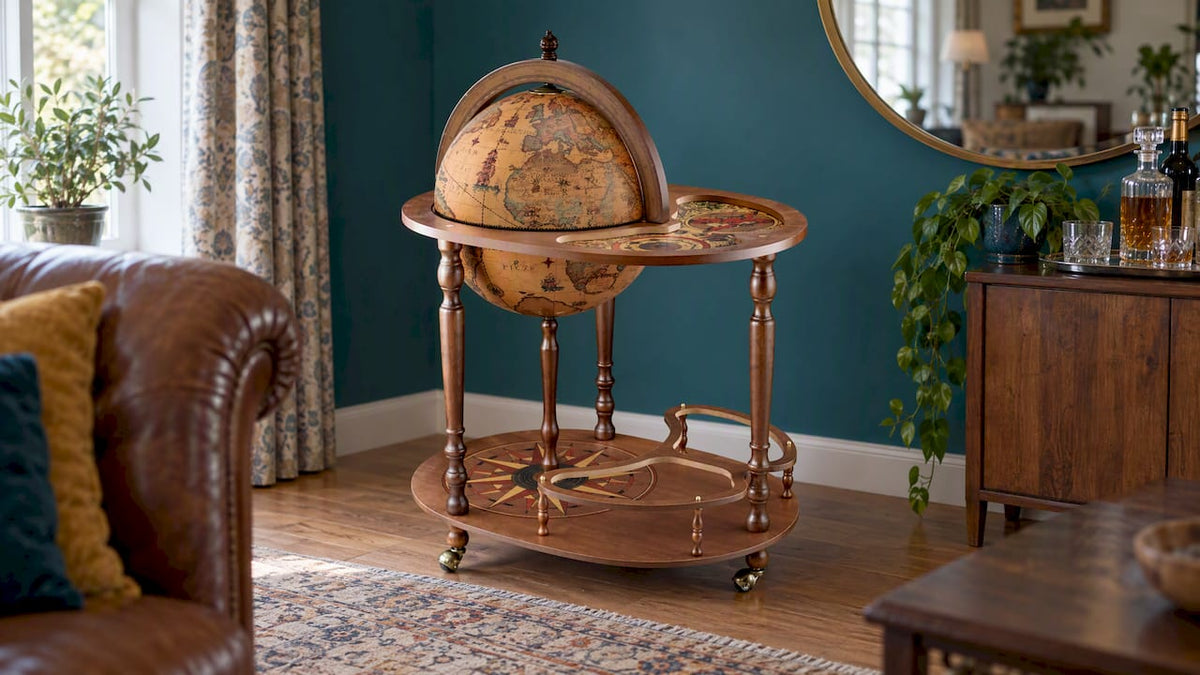
An Art Deco globe bar is a sphere on a stand that opens to reveal a hidden cabinet for bottles and glasses. It is built around the same ideas as the 1920s and 30s style: symmetry, clean geometry, rich materials and a little theater. The best ones pair a warm, polished finish with restrained metallic details. They also hold the bottles you actually own. Below you will find what makes a globe bar read as Art Deco, how to place and style it, and what to check before you buy.
TL;DR
- Art Deco is about streamlined, symmetrical, geometric forms in premium materials. A globe bar suits it naturally: a perfect sphere on a stand is symmetry in one object.
- Choose a finish you can pair with brass, gold or mirror. Use metal to trace the form, not to cover it.
- Measure your tallest bottle and your favorite tumblers before you fall in love with a model. Interior sizes vary a great deal.
- If you will serve from it often, pick a model with a shelf or working surface.
- Place it where guests naturally gather, and test the finish under evening light.
Table of Contents
- What makes a globe bar “Art Deco”
- Vintage originals or new handcrafted pieces
- The finishes and details that carry the style
- Where to put it: placement and styling
- Floor, desk or bar: choosing the format
- Check the practical details before you buy
- Our view: why craft matters in a Deco globe bar
- Find your globe bar
- A simple checklist for your Deco setup
- FAQ
- Sources
What makes a globe bar “Art Deco”
Strictly speaking, Art Deco is a period, not a product category. Design that flourished in the 1920s and 30s favored bold geometry, symmetry and luxurious materials, with an air of glamour. A globe bar is a mid-century idea that arrived a little later, but it fits that spirit easily. The sphere is the purest geometric form there is, and the stand and ring around it add the structured, architectural lines the style loves.
The invention itself is Italian. The bar globe was created by Italo Zoffoli in Rimini in the late 1940s, and the same source notes that the Museum of Science and Technology in Milan recognized it for design innovation in 1963. Our company has made globes in Italy since 1949, so this is a tradition we know from the workshop floor, not from a catalog.
When people search for an Art Deco globe bar, they usually mean one of two things. Some want a true period piece, such as a vintage cabinet from the 1940s. Others want a new piece with an Art Deco temperament. Both are valid, and the right answer depends on how you plan to use it.
Vintage originals or new handcrafted pieces
A period globe bar has undeniable charm. Dealers list pieces such as a French Art Deco world globe bar from the 1940s, and an original carries its own history. Collectors who love that lived-in quality often say a few nicks are part of the appeal, and that gentle polishing restores a piece’s elegance without erasing its past.
The trade-off is practical. Vintage interiors were designed for the bottles of their day, and a modern spirits shelf can hold taller, wider and oddly shaped bottles. Finishes may be fragile, and condition is something you must judge from photos. If you are drawn to the collecting side, a guide to decorative arts for collectors and enthusiasts explains what to look for in provenance and condition.
A new, handcrafted globe bar gives you the look with fewer compromises. You get current cartography, a finish in good condition, and a cabinet planned for real glassware. For many homes it is the better daily companion, and it can still become an heirloom.

The finishes and details that carry the style
Three decisions shape how Art Deco a globe bar feels: the color of the body, the metal, and the map.
Body color and warmth
Deep woods, lacquered darks and ivory whites all work. Dark, glossy surfaces give the classic Deco contrast. A pale, all-white body feels lighter and more contemporary while keeping the same symmetry. Our Elegance all-white floor bar globe is a good example of the second approach: a quiet, luminous object that lets your brass and glass do the talking. You can read more about that line in our note on the Elegance collection.
Brass and gold, used with restraint
Designer Brad Smith’s point, as reported in a roundup of Art Deco bar ideas, is that proportion matters more than the materials themselves. Brass or gold should highlight the form, not overwhelm it. In practice that means a metal ring, a trim line or a set of legs, with the rest of the room echoing that note in small doses: a tray, a lamp base, a mirror frame.
If you want to think through metallic accents room by room, this step-by-step home decorating guide is a useful companion for planning color and finish before you buy.
The map itself
Art Deco leans toward graphic clarity, so a clean, modern map with crisp lines is a natural fit. If you prefer something more evocative, an antique-style map brings a softer, traveled feeling. Think of the map as the pattern in your room: choose it as you would a wallpaper. Our Tele Antiche collection takes the antique route, and our classic style globes offer more traditional looks.
Where to put it: placement and styling
A globe bar is a focal point and a piece of furniture at once, so placement matters. The Art Deco bar guidance we reviewed recommends balancing glamour with utility: use mirrors to amplify the space, test finishes under evening light, and put the bar where it encourages people to mingle.
A corner with a mirror
A floor globe bar in a corner, with a mirror or a mirrored panel behind it, doubles the sense of depth and catches the light from nearby lamps. Because the sphere is round, it looks good from every angle and never feels like a flat piece pushed against a wall.
The edge of the living area
Place it where the room opens to the sofa or dining table, not tucked into a hallway. Guests will drift toward it, which is exactly the social energy Deco interiors were designed for. Leave about an arm’s length of clear floor in front so the lid can open fully and two people can stand comfortably.
Evening light matters most
Most drinks are poured after dark. Look at the finish under the warm bulbs you actually use at night. Gloss can look dazzling in daylight and glare under a bare bulb, while a satin surface can look flat. A small table lamp with a brass base nearby usually makes everything look better.
What to put around it
Keep the surroundings edited. A tray with two or three crystal tumblers, a single decanter, and perhaps a geometric mirror will frame the globe. Resist covering every surface: Art Deco rewards a few confident objects over a crowded display.
Floor, desk or bar: choosing the format
Not every Art Deco room has space for a floor model, and not every globe has to hide bottles.
- Floor bar globes are the statement. Our globe bar collection is built for hosting.
- Floor globes without a cabinet are sculptural. See our floor globes.
- Desk globes bring the same polish to a study or shelf. Our gold desk globe is a natural match for brass-led Deco schemes.
If you plan to host regularly, a model with an integrated lower shelf or working surface is better than a basic sphere, because it keeps bottles and glassware organized while you pour. Our Vesuvio bar globe and Afrodite floor bar globe are two places to start looking at how different designs handle that.
Check the practical details before you buy
A globe bar is decorative functional art, not a precision geographic instrument, and the practical side deserves as much attention as the looks. One German review of globe bars makes the point plainly: internal dimensions vary significantly, and some models cannot fit large or unusual modern bottles.
Before ordering, do this:
- Measure your tallest bottle, including any stopper or pourer.
- Measure the widest base among your bottles, since some liqueur and gin bottles are broad.
- Check the glass you use most, such as rocks glasses, coupes or stemware, against the interior or the shelf.
- Measure the floor space and the clearance above for the opening lid.
- Decide how much you want to store inside and how much you will display outside.
If you want to see how a bar globe is organized inside, our article on what is inside a bar globe walks through it.
Our view: why craft matters in a Deco globe bar
We think the best Art Deco globe bar is the one that looks as good closed as it does open. That takes craft in the parts you do not photograph: the way the sphere closes, how the interior is lined and fitted, how the finish is applied and checked. We design and produce our globes in Italy, working with fine materials and updated cartography, and each piece is meant to be a functional object and a work of art at once.
We also believe a globe bar should earn its place in daily life. A piece that is too delicate to open, or that cannot hold a regular bottle, becomes an ornament you stop using. So when we talk with customers choosing between a classic and a modern look, we ask first how they entertain, then which room it will live in, and only then which finish.
And Deco is a good guide to all of it: choose fewer things, make them well, and let the proportions do the work.
— Zoffoli
Find your globe bar
If you are ready to choose, start with our globe bar collection, or explore the full range on the Zoffoli home page. Our collections cover bar globes, table globes, floor globes, the iconic premium line and the antique-canvas Tele Antiche, so you can match a finish to the room you have in mind.

A simple checklist for your Deco setup
Put it together in this order and the room will almost style itself.
First, choose the globe: its finish, map and format. Second, pick one metal for the room, brass or gold, and repeat it two or three times. Third, add a mirror to catch the light. Fourth, set a tray with a few glasses and one decanter. Finally, sit in the room at night and adjust the lamps until the finish glows rather than glares.

FAQ
Is a globe bar really Art Deco?
The style comes from the 1920s and 30s, while the globe bar was introduced in the late 1940s, so strictly it is a later idea. It shares Deco’s symmetry, geometry and love of rich materials, which is why it sits so comfortably in Deco rooms. Choose a finish and metal accents that echo the period and it will look entirely at home.
What finish works best for an Art Deco home bar?
Dark glossy surfaces give classic contrast, while an all-white body feels lighter and more modern. Pair either with brass or gold used sparingly to trace the form. Test the finish under your evening lighting before deciding.
How do I know my bottles will fit?
Measure your tallest bottle, your widest base and your most-used glasses, then compare them with the model’s interior. Internal dimensions vary significantly between globe bars, and some cannot hold large or unusual bottles. If you host often, choose a model with a lower shelf or working surface.
Should I buy vintage or new?
Vintage gives you history and character, but condition, finish and bottle fit can be uncertain. A new handcrafted globe bar gives you updated cartography, a fresh finish and a cabinet designed for modern bottles. Many people choose new for daily use and keep a vintage piece for display.
Sources
- Art Deco Interior Design: Everything You Need to Know, Architectural Digest
- Who invented the bar globe? 1stDibs
- French Art Deco World Globe Bar, circa 1940s, 1stDibs
- Art deco home bar furniture set up and ideas, Kindred Spirits Cocktails
- 10 Art Deco Bar Ideas for a Glamorous Home Setup, Omni Home Ideas
- Globus-Bar: Die 5 besten Modelle im Vergleich, maltwhisky.de
- Decorative Arts: What Collectors and Enthusiasts Need to Know
- Step by step home decorating: your complete guide