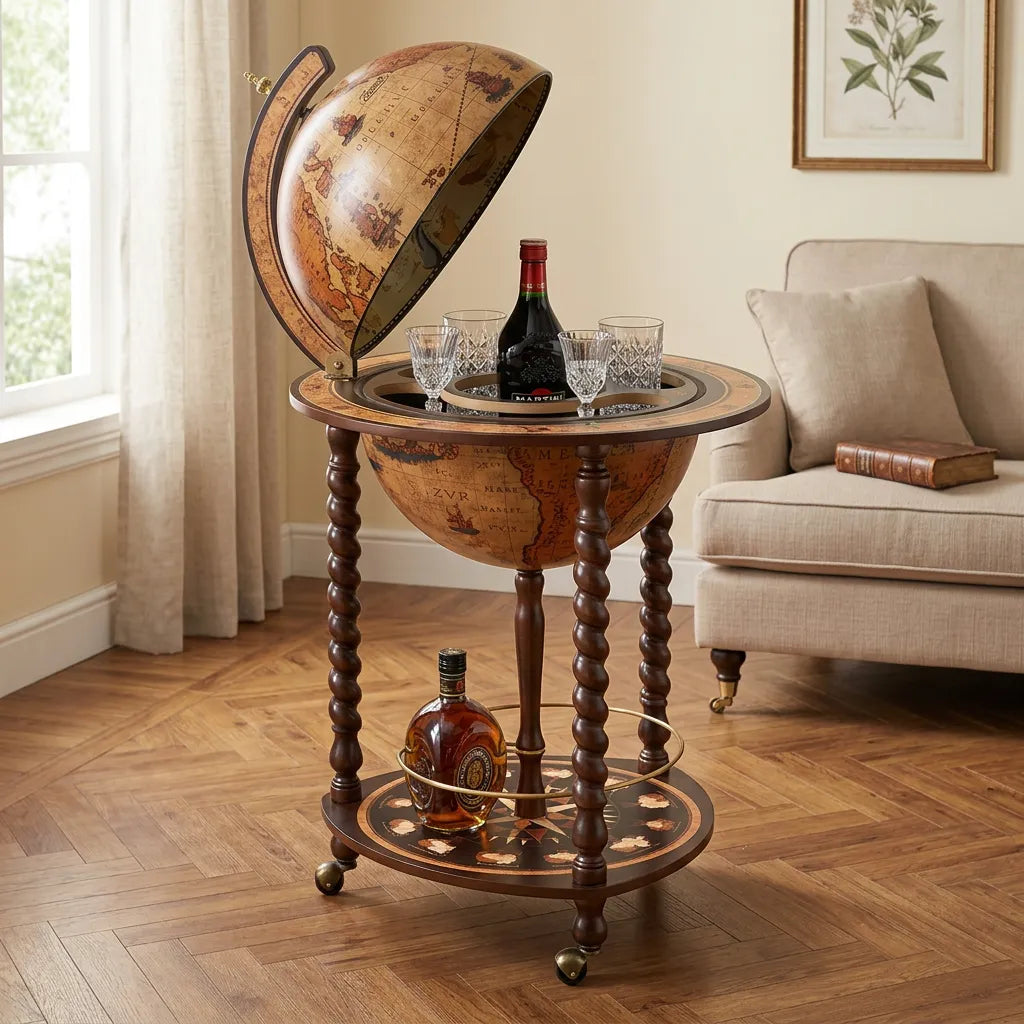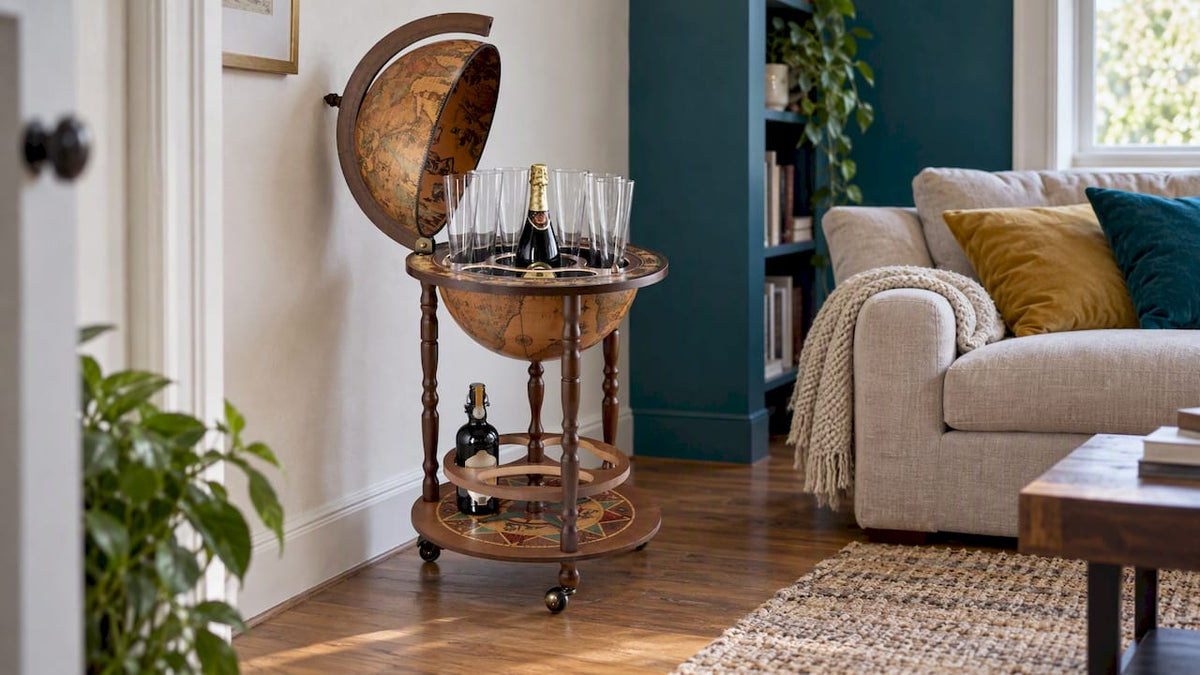
An antique style globe bar gives you the look of an old-world map sphere with a working drinks cabinet hidden inside. It is a modern, handcrafted piece made to evoke the 16th to 18th centuries. It is not a genuine antique, and that is a strength: it holds bottles and glasses, tolerates everyday life and costs far less than a vintage original. This guide explains what to look for, how it differs from a true antique, and how to make it feel at home in your living room.
TL;DR
- An antique style globe bar is a new piece with an aged-looking map. A true antique or mid-century vintage bar is a different purchase, with different care needs and a very different price.
- Judge a reproduction by how well the map is applied, how the sphere turns, how the lid closes and what the base is made of.
- Warm, aged tones (rust, brown, verdigris) suit traditional rooms. Cleaner finishes suit modern interiors.
- Keep the bar away from radiators, direct sun and damp walls. Humidity below 65% protects wood and paper.
- Our Giove, Giunone and Da Vinci bar globes are made in Italy, where globe bars began.
Table of Contents
- What an antique style globe bar really is
- Antique, vintage or antique style: three different purchases
- How to judge a well-made reproduction
- Table, floor or cart: choosing the format
- Antique style in a modern home
- Where to put it, and how to protect it
- Planning the space around the bar
- Our perspective
- Find your globe bar
- FAQ
- Sources
What an antique style globe bar really is
A globe bar is a bar cabinet tucked inside a world globe. According to 1stDibs, Italo Zoffoli invented it in the late 1940s in Rimini, Italy. The sphere splits open, usually from the top, to reveal shelves or a fitted interior for bottles and glasses.
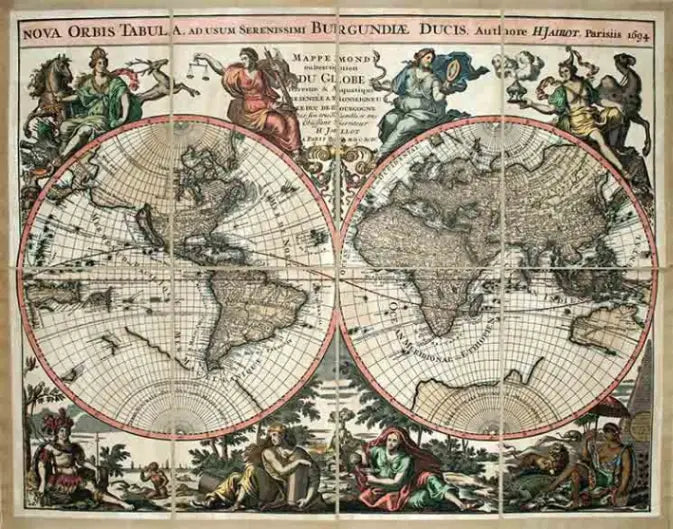
The word antique style describes the surface, not the age. The map is typically a reproduction of a historical chart, and research on reproduction globe bars points to 16th to 18th-century nautical charts as the usual source. The tone is deliberately worn: sepia oceans, faded rust, parchment beige, soft verdigris. The result looks lived in, but the object underneath is new and built to be used.
That matters for how you buy. A reproduction should be judged as furniture and as craft, not as a collector’s artifact.
Antique, vintage or antique style: three different purchases
The three terms get mixed up in search results, so it helps to separate them.
True antiques
Globes made before about 1930 are antiques in the collector’s sense. They were made of paper, plaster and wood, materials that need stable, controlled conditions. They are also fragile: heat and humidity damage them, and amateur cleaning, such as household cleaners on a paper surface, can permanently reduce their value. Most were never designed to hold a bottle of whiskey that might drip.
Vintage globe bars
Mid-century globe bars have their own charm and a real market. On the resale site 1stDibs, vintage globe bars typically range from $850 to $9,000, with an average sale price of about $2,245. One UK dealer listing describes a mid 20th century globe drinks cabinet with a 50 cm globe fitted out for bottles. These pieces are charming, but condition varies, and the interior fittings, hinges and finish have all aged.
Antique style, new made
A new handcrafted bar gives you the aesthetic without the conservation burden. Contemporary Italian-style bars often use cellulose-polymer spheres and laminated MDF for stability, which suits a room with central heating and a busy host. You also get current manufacturing, fresh finishes and, with a brand that stands behind its work, support if something goes wrong.
If you want a piece of history, buy a genuine vintage or antique and care for it as a collector would. If you want to entertain with something that looks like history, an antique style bar is the sensible choice.
How to judge a well-made reproduction
Photographs flatter everything, so know what to inspect before you commit.
The map and its gores
A globe map is printed as curved paper segments called gores, and they are glued to the sphere. Enthusiasts are encouraged to look at how precisely the gores align, because that is the clearest sign of careful workmanship. Check the seams near the poles and along the equator. Lines and coastlines should continue across a joint without a visible step.
Also look at the print itself. A convincing antique style map has soft ink, crisp lettering and cartouches, sea monsters or compass roses that feel drawn rather than pixelated.
The opening mechanism
The lid should lift smoothly and stay open without drifting. When it closes, the seam should nearly disappear, so the sphere reads as a globe and not as a box. Some designs use a gas strut or a hinged hemisphere. Test the feel in a video or in person if you can.
Sphere, legs and base
A sphere that is rigid and evenly round will turn without wobbling. Wood legs, a stable base and, on floor models, hidden casters make a bar easy to position. Ask what the base is made of, and whether assembly is required.
The interior
A bar globe is only as good as its interior. Look for a layout that fits standard-height bottles, with a place for glasses, and finishes that wipe clean. If the interior is bare, you will be improvising with trays and racks.
Table, floor or cart: choosing the format
The best format depends on the room more than the taste.
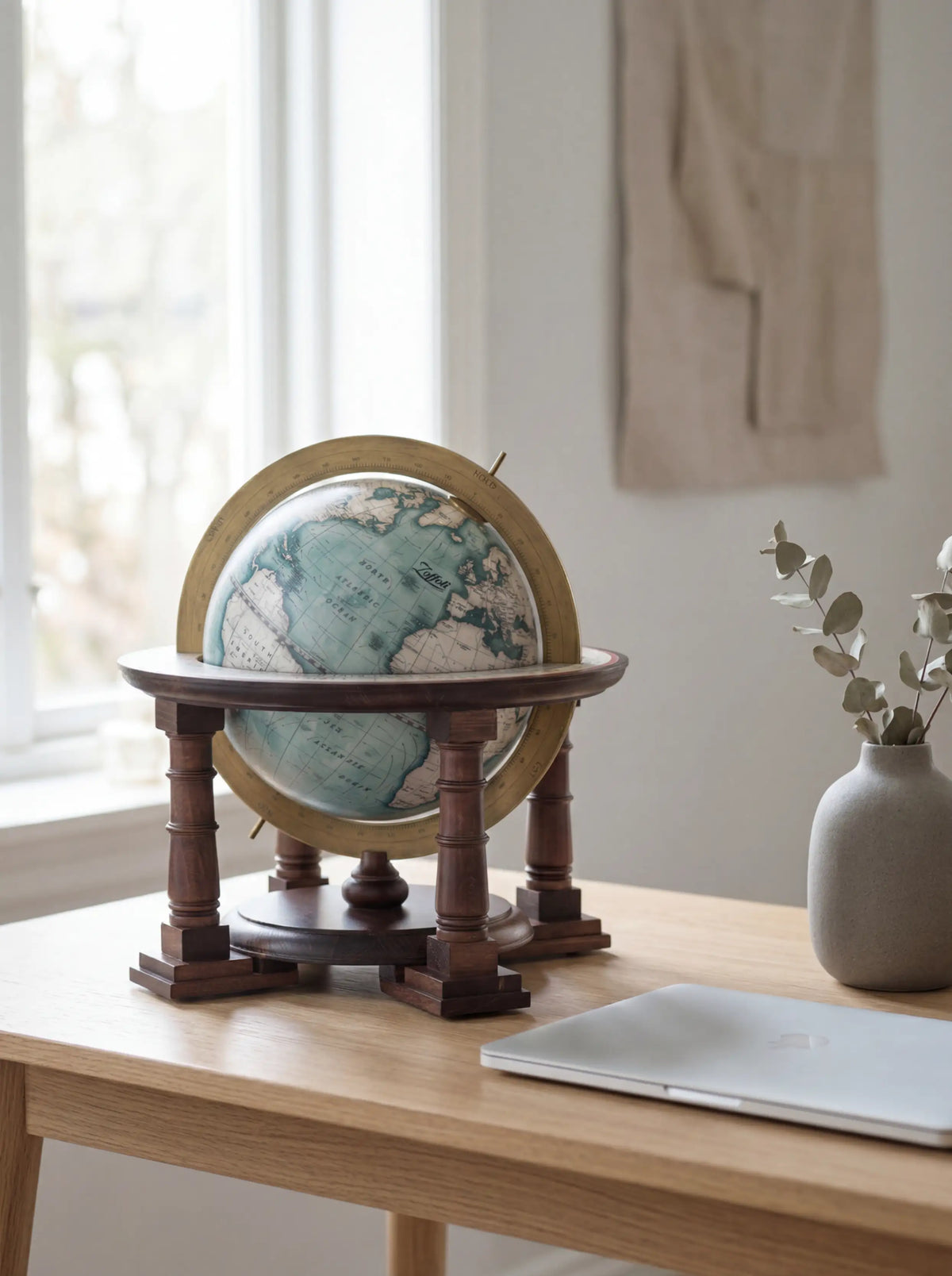
A tabletop globe bar suits a console, sideboard or study desk. It holds a few bottles and a handful of glasses, and it is the easiest way to bring a globe into a small living room. Our Giove rust tabletop bar globe is built for exactly that role: a warm, rust-toned sphere that sits at conversation height.

A floor-standing bar is a statement piece. It is closer to a piece of furniture, with more storage and more presence. Our Giunone floor-standing globe bar and the Da Vinci rust floor-standing bar globe both follow this idea. They suit a corner, a library nook or the end of a long room.
A bar cart is the third path. It is mobile and works well for large gatherings, but it reads as bar equipment first and a globe second. If you want the object to be a focal point even when no one is drinking, a standing globe usually wins.
Antique style in a modern home
A recurring question is whether an old-world globe can sit in a contemporary room. It can, if you pay attention to three things.
Color. Rust, deep brown and verdigris bring the warmth of aged copper and leather to a room, and they pair well with walnut, oak, linen and brass. In a pale, minimalist space, a single dark globe becomes the one anchor that makes the room feel inhabited.
Proportion. Match the size of the globe to the furniture around it. A large floor globe next to a slim sofa will dominate. A tabletop globe on a deep credenza will look lost. Leave a hand’s width of breathing room on each side.
Contrast. Antique maps look best against clean backgrounds. A plain plaster wall, a simple bookshelf or a quiet rug lets the cartography do the talking. If your room is already ornate, choose a simpler, more graphic map.
If you want a more modern or contemporary take, look at finishes and legs. Slim legs, a lighter map palette and a restrained base give the same function with a less traditional feel.
Pairing the globe with framed maps
A globe on its own can feel isolated. Hanging a framed antique view nearby ties the story together. Our Tele Antiche collection offers canvas prints of historical views and maps, such as the view of Rome, the view of Naples, the view of Milan, Italy by Rizzi Zannoni and an antique celestial planisphere. Black and white canvases keep the wall quiet, so the colored globe remains the star.
Where to put it, and how to protect it
A reproduction is sturdier than an antique, but wood and paper still respond to their environment.
Keep the bar away from radiators, vents and long hours of direct sun. Heat dries glue and wood, and sunlight fades inks. Avoid placing it against an exterior wall that sweats in winter. For wooden furniture and paper surfaces, conservation guidance advises keeping relative humidity below 65% to prevent timber decay, mold and paper warping. A small hygrometer costs little and tells you whether your room is in range.
For cleaning, be gentle. Dust the sphere with a soft, dry cloth. Do not use household sprays on the map surface, and avoid aerosol polishes on the wood: Canadian conservation guidance warns that products containing silicones and oils can be incompatible with some finishes. Wipe spills inside the cabinet right away, and store bottles upright.
If you own a true antique or a valuable vintage globe, the rules are stricter. Conservators caution that improper quick fixes by owners often destroy the original varnish and map detail. In that case, consult a professional globe conservator before you touch it.

Planning the space around the bar
A globe bar is self-contained, but it works better with a thoughtful setting. Think about where guests will stand, where glasses will rest and where you will keep ice, mixers and extra bottles. If you are building a larger home bar zone, with shelving or a cabinet beside the globe, a guide to home bar cabinetry design and planning can help you think through storage, lighting and layout before you commit to a build.
A few practical habits help. Put a tray on top of the console under a tabletop globe so condensation rings never reach the wood. Light the corner with a warm lamp rather than a spotlight. Keep the glassware you use most inside the globe, and the rest nearby, so the cabinet never feels crowded.
Our perspective
We have made globes in Italy since 1949, and the bar globe is part of that story. What we have learned is that people do not really want a museum piece in their living room. They want an object with presence that they can use, and that still looks right ten years from now.
That is why we think of an antique style bar as a piece of functional art. The map brings the tradition, the craftsmanship brings the quality, and the cabinet brings the reason to open it with friends. We produce our globes in-house, we offer both classic and modern aesthetics, and we pay attention to finishes, because a globe is something you look at every day.
Our advice is simple. Choose the map and color that make you want to look twice. Choose the format that fits your room. And choose a maker who can tell you how the piece was built.
— Zoffoli
Find your globe bar
If you are ready to choose, begin with the pieces that best fit the antique style described above. Giove is our rust-toned tabletop bar, Giunone is a floor-standing bar, and Artemide offers another design to compare. For the most distinctive designs, see Gli iconici. You can browse the whole range on our home page.

FAQ
Is an antique style globe bar a real antique?
No. It is a new piece made to look aged, usually with a reproduction of a historical map. Genuine antiques date from before about 1930 and are made of paper, plaster and wood. If you want to use a globe as a working bar, a new antique style piece is the more practical choice.
How much does a vintage globe bar cost compared with a new one?
Vintage globe bars on the resale market typically run from $850 to $9,000, with an average sale price of about $2,245. A new antique style bar is a different purchase: you get current construction and finishes, and no restoration to arrange. Check the price on each product page for current figures.
Can a globe bar work in a modern living room?
Yes. Choose a restrained base, simple legs and a map palette that matches your room, then leave space around it. A single rust or brown globe in a neutral room usually looks intentional, not themed.
How do I look after a globe bar?
Dust it with a soft, dry cloth and keep it away from heat, direct sun and damp walls. Aim for humidity below 65%, avoid silicone or oil polishes on the wood, and wipe spills inside the cabinet at once. For a true antique, ask a professional conservator before any cleaning.
Sources
- Who invented the bar globe? 1stDibs Q&A
- Globe Dry Bar listings, 1stDibs
- Antique globe identification guide, Antique Identifier
- Restoring a globe professionally, Collecting Antique and Vintage Globes
- Vintage Globe Drinks Bar Cabinet, Antiques Atlas
- Storage Solutions for Oversized Paper Artifacts, NEDCC
- Care of wooden furniture guidelines, Canadian Conservation Institute