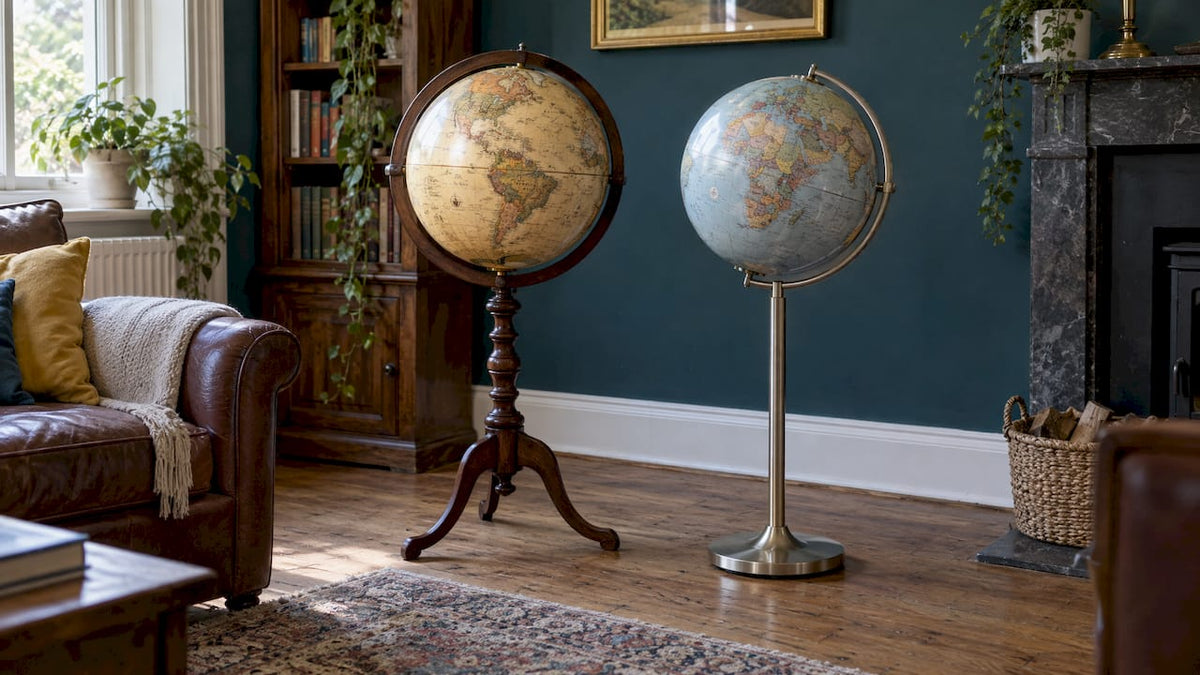
Choose wood if you want a warm, furniture-grade look in a library or formal living room, and choose metal if you need a slimmer, more durable stand for an office or busy corner. We make globes by hand at Zoffoli, and we see the split clearly: wood moves with humidity, while powder-coated metal shrugs it off.
TL;DR:
- Wood expands and contracts as humidity changes, so place it in a stable, dry room away from radiators, vents, and direct sunlight.
- For larger floor globes, choose a broad wooden base or weighted metal foot; base width and center of gravity matter more than material.
- Metal with a powder coating handles humidity and frequent cleaning well, but touch up chips quickly to keep moisture from reaching exposed metal.
- For outdoor placement, choose a metal stand designed for outdoor use and check that its protective coating can withstand exposure.
- Match the stand to the sphere and meridian, and ask whether it can be repaired; a durable piece may outlast cheaper replacements.
Table of Contents
- How do metal and wood globe stands compare side by side?
- Which stand should you buy? A step-by-step checklist
- How do you keep a stand stable and looking its best?
- Which material is kinder to the environment?
- What do wood and metal stands cost, and what do you get for it?
- Which Zoffoli globes work with which stand?
- Zoffoli’s view on stand design
- Why we recommend Orbis for most readers
- FAQ
- Sources
How do metal and wood globe stands compare side by side?
Several things decide this choice: how the stand looks, how it handles its environment, how steady it is, how much care it needs, and where it will live. Here is how the two materials stack up on each.
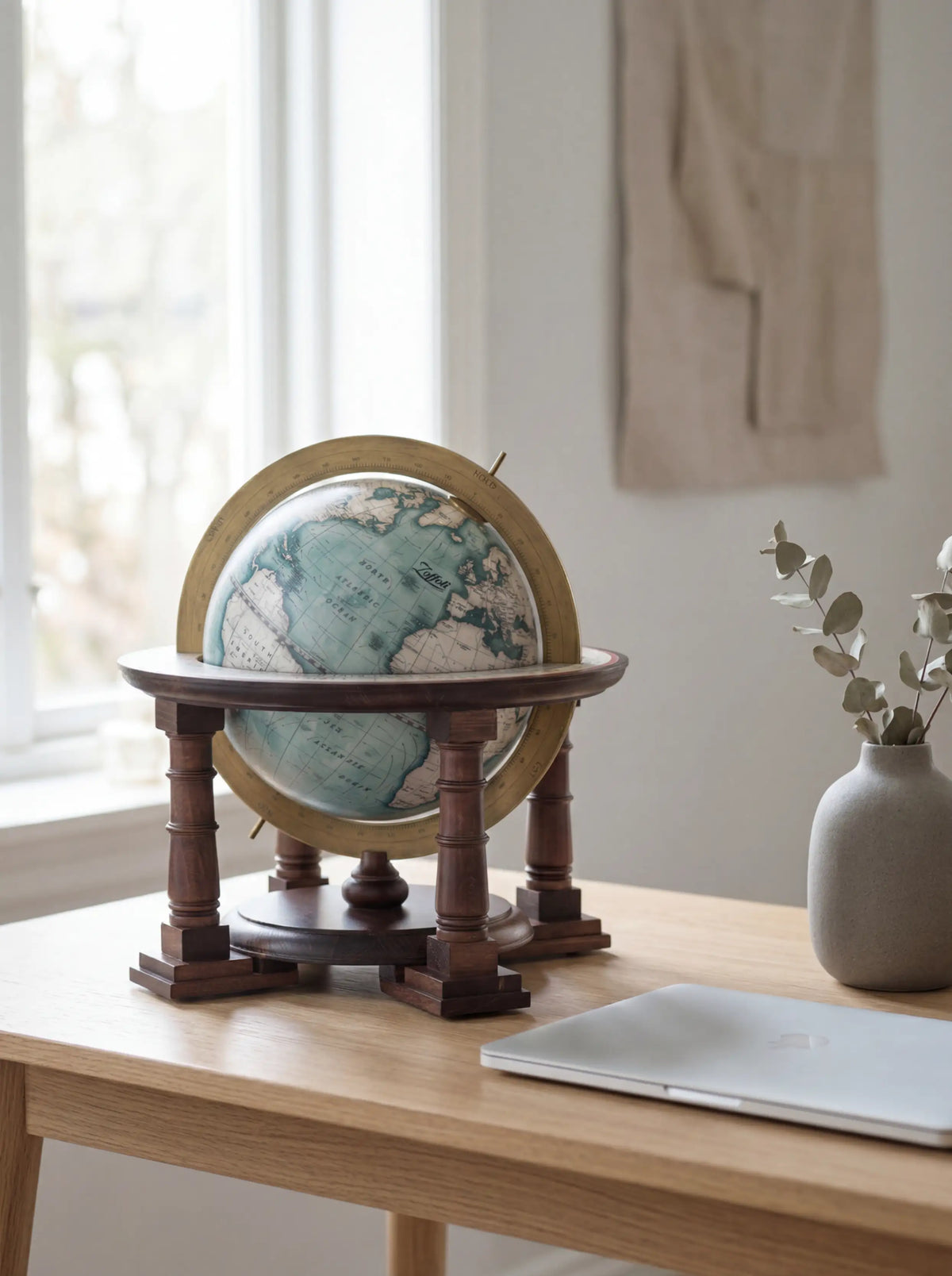
Appearance. Wood, such as walnut or beech, gives a stand the presence of a piece of furniture. The grain adds warmth and visual weight, so a wooden base tends to anchor a room and suits traditional or formal decor. Metal has a slender profile that reads as modern and light, which helps on a crowded desk or in a minimalist space. Finish matters as much as material: a dark stain makes wood feel classic, while a matte or satin metal coating keeps a contemporary room calm.
Durability and environment. Wood is hygroscopic, meaning it takes in and gives off moisture as humidity changes. Conservation research from the Getty explains that wood expands and contracts with humidity, and in a stand that movement is held in place at the joints, so swings in the air can cause cracks or warping. Careful construction and stable indoor conditions keep this in check, and a well-built wooden stand can last for generations. Metal is generally less bothered by humidity and temperature swings. A good metal stand is usually powder-coated, which protects it from scratches, moisture and corrosion.
Stability. Weight and base footprint matter more than material. A stand wobbles when its center of gravity sits too high or its base is too narrow, and weak joints make it worse. Wood is naturally heavy and wide, which suits larger globes. Metal can be just as steady if the base is broad or weighted. For a tabletop globe, look for a base wide enough that the globe cannot tip when you spin it. For a floor globe, a broad base or weighted foot is worth more than any choice of finish.
Maintenance. Our recommended routines are short:
- Wood: dust regularly with a soft cloth and apply furniture polish occasionally to keep the finish healthy.
- Metal: wipe it down with a damp cloth and touch up any chipped coating before moisture reaches the bare surface.
- Both: call a maker or conservator when you see cracks, joints pulling apart, or active rust.
Suitability and placement. Wood belongs in libraries, studies and formal living rooms, where its warmth fits the surroundings. Metal suits offices, hallways and other high-traffic areas, where a slimmer footprint and easy cleaning count. Outdoors, wood generally needs weatherproofing, so a stand built from metal for outdoor use is the safer route. Product listings for outdoor metal stands, such as this steel garden globe stand, point to powder-coated or welded finishes made to weather the elements.
Which stand should you buy? A step-by-step checklist
Start by writing down four facts: the diameter of your sphere, the room it will sit in, whether it goes on a table or the floor, and how much upkeep you are willing to do. Every globe has three parts you will see named in listings: the sphere, the meridian (the ring around it) and the stand. The Whipple Museum describes these parts in its pocket globe collection. Treat them as a matched set, because a fine sphere on a mismatched stand loses both beauty and usefulness.
Then work through the decision in order:
- Assess size and stability. Smaller tabletop spheres can sit well on a narrow metal meridian stand. Larger floor globes call for a broader wooden base or a weighted metal one.
- Pick the material for the room. Choose wood for a formal, dry, temperature-stable space and metal for a busy, bright or humid one.
- Choose the finish and check compatibility. Confirm the stand fits your sphere and meridian, then pick a finish that matches the furniture around it.
If you keep wavering, ask which quality you would miss most: warmth or ease of care. Warmth points to wood. Ease points to metal. For a wider look at what we offer, browse our handcrafted decorative globes and see how each finish changes the feel of a room.
How do you keep a stand stable and looking its best?
Good care is mostly about keeping conditions steady and keeping materials apart.
- Control humidity. Wood moves with the air, so aim for consistent indoor humidity. Keep stands away from radiators, vents and strong direct sun, and avoid storing them in damp or fluctuating spaces.
- Protect metal. Choose powder-coated or painted finishes, wipe them regularly, and dab touch-up paint on chips quickly.
- Isolate the joints. A literature survey on wood and metal corrosion found that the two can form corrosion-prone pairings in moist conditions. Prevention comes from isolation, compatible fasteners and protective coatings, so a barrier between fasteners and wood is worthwhile.
- Watch for warning signs. Cracks, separating joints and active corrosion all need a maker’s or conservator’s attention.
Pro Tip: Keep any original parts, such as screws, washers and mounting hardware, and check with us before attempting an aggressive repair.
Which material is kinder to the environment?
Neither material wins automatically, because the answer depends on how a stand is made and how long it lasts. A wooden stand starts from a renewable resource, and wood from responsibly managed forests can be a sound choice. Its footprint depends on sourcing, finishing products and transport.
Metal takes more energy to produce, but it is durable and can often be recycled at the end of its life. A metal stand that serves for decades, then goes back into the scrap stream, has a respectable story to tell.
The most sustainable stand is usually the one you keep. A well-made piece of either material beats a cheap replacement bought every few years. That is why we put craft ahead of speed. When you shop, ask where the material comes from, what coating or finish is used, and whether the stand can be repaired rather than discarded.
What do wood and metal stands cost, and what do you get for it?
We do not publish a universal price list for either material, so treat what follows as general guidance. Wooden stands often cost more where the wood is a species like walnut and the joinery is done by hand. Metal stands can be more affordable, especially simple powder-coated designs, though a hand-finished metal base is a craft object too.
Value depends on more than the number on the tag. A wooden stand brings warmth and furniture-grade presence, and it can be refinished and cared for over many years. A metal stand brings low upkeep and resilience, which spares you the cost of care. Collectors tend to judge sphere, meridian and stand as separate components, and a mismatched stand pulls down the worth of an otherwise fine globe.
So ask what you will actually use. If you want a centerpiece, spend on the finish and the look. If you want a dependable daily companion, spend on stability and the coating. Current prices for our models are available on our site, and you can reach us for details on a specific pairing.

Which Zoffoli globes work with which stand?
Our range spans several families, and each one handles stand choice a little differently. Our Mappamondi da tavolo are made for desks and shelves, where a compact, steady base matters most. Our Mappamondi da terra are floor globes that need a broader footprint. A model like the Vertigo floor globe shows how finish and scale change the way a floor piece sits in a room.
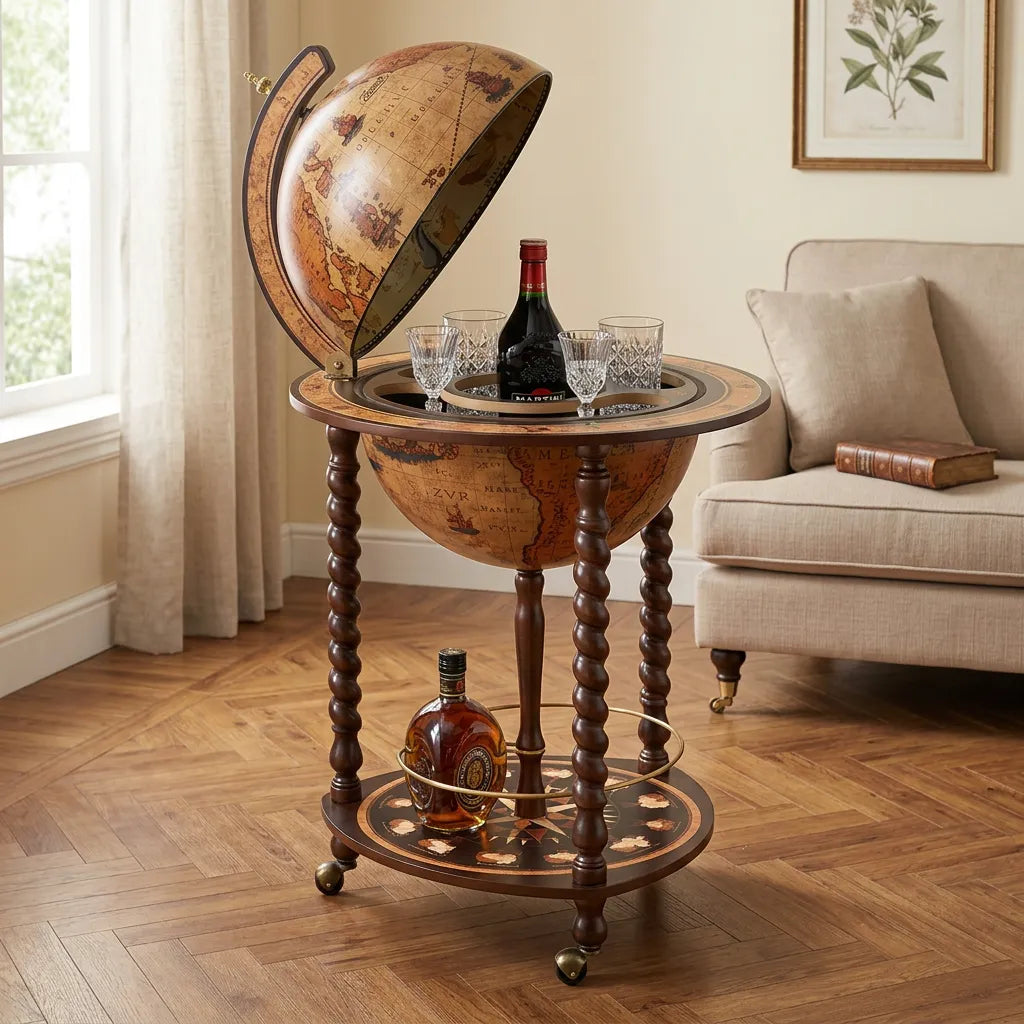
For larger statement pieces, the Dedalo floor-standing globe bar is a good example of why a wide, stable base matters when a globe does double duty. Our Mappamondi bar collection pairs the sphere with a functional interior, so the base has to carry real weight. And Sirio shows how a design globe can take on a different personality depending on its finish.
If you are drawn to heritage, our Gli iconici premium line and our Tele Antiche collection suit rooms where a classic look counts. Our advice is simple: match the visual weight of the stand to the sphere, then match both to the room.
Zoffoli’s view on stand design
We treat the sphere and the stand as one matched pair. Our priorities are scale, craftsmanship and finish, tuned to the room and the way the globe will be used. We offer finish options and are happy to talk through custom pairings. If your placement is unusual, or you expect heavy daily use, contact us before you choose a material, and we will help you land on the right one.
— Zoffoli
Why we recommend Orbis for most readers
Orbis is our handcrafted pick for modern spaces that want a steady, low-maintenance globe.

FAQ
What are the parts of a globe called?
Every globe has three main parts: the sphere, the meridian and the stand. The meridian is the ring that encircles the sphere, and the stand holds the whole assembly. The Whipple Museum uses this same breakdown when describing globes in its collection.
What is a pocket globe?
A pocket globe is a small globe that fits in the hand, usually housed in a case. Historically these served as status symbols and teaching tools. The Whipple Museum notes that they typically measure around 3 inches (7.5 cm) across.
Where should you place a globe at home?
Put it where you can see and touch it, away from strong direct sun and heat sources. Wood suits libraries and formal living rooms, while metal works well in offices and busy areas. Leave enough clear space around the stand so the sphere can turn freely.
What are the three main types of globes?
Globes are commonly grouped by how they are used and displayed, including tabletop globes, floor-standing globes and compact pocket globes. Some are decorative, and some, like our globe bars, also serve a function. Choosing among them comes down to size, space and purpose.