A globe on a metal stand is the right choice when you want a slim, durable base that lets the map take center stage. Brass gives you warmth and an aged look, steel or powder-coated metal gives you a cleaner, modern line, and wood remains the traditional alternative. The stand does more than hold the sphere. It sets the tone of the whole object, decides how well it handles daily spins, and determines how the globe sits in your room.
Below, we walk through the metals you will meet, how they compare with wood, what the globe itself is made of, and how to judge quality before you buy.
TL;DR
- Metal is generally the more durable base, and it suits modern and transitional rooms. Brass adds a warm, vintage character that deepens with age.
- Wood bases feel traditional and substantial. Many of the finest globes combine both: a wood foot with a metal meridian arc.
- Look at the meridian, the axis point and the weight of the foot. These three details tell you more about quality than the price tag.
- The globe ball matters as much as the stand: paper, cellulose and plastic behave differently over time.
- Brass can be cleaned, but harsh polishing removes the patina many people buy it for.
Table of Contents
- What “metal stand” really means
- Brass: warmth that gets better with age
- Steel, iron and powder-coated metal
- Wood versus metal: how to decide
- The globe itself: paper, plastic, cellulose
- What separates a quality globe from a decorative prop
- Where a metal stand globe fits in your home
- A note from our workshop
- Choosing from our collections
- Buying checklist
- FAQ
- Sources
What “metal stand” really means
When shoppers search for a globe on a metal stand, they usually mean one of three things. Each is a different design, with a different feel.
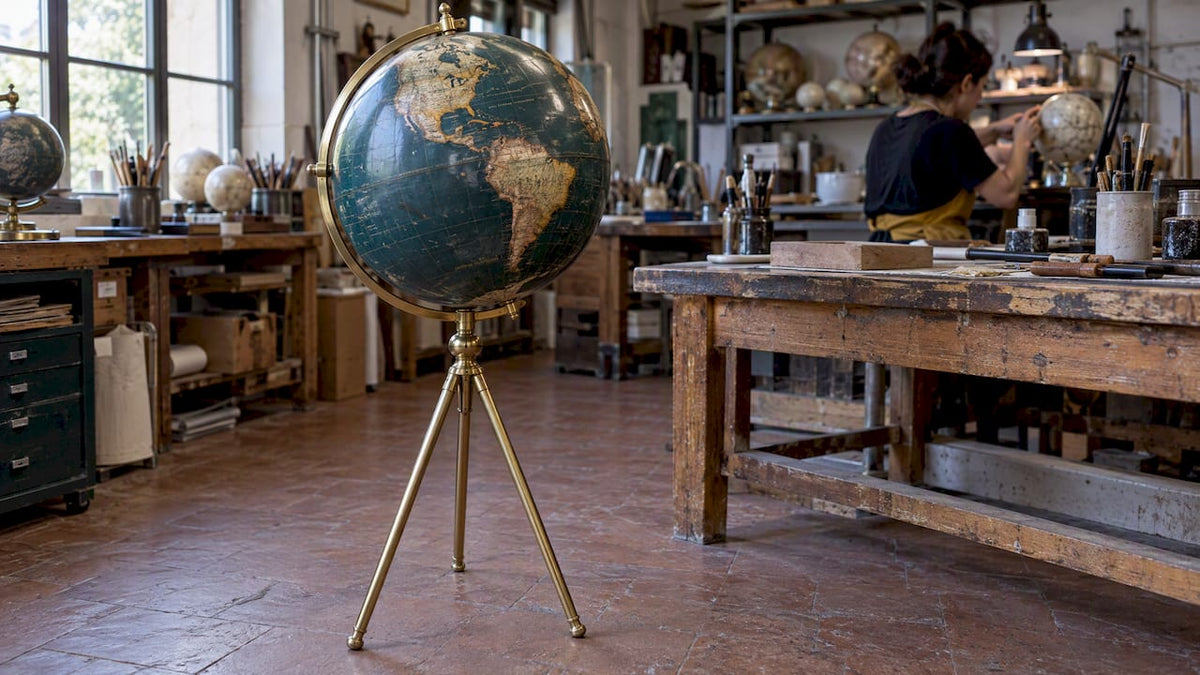
The tripod or pedestal. Three slender metal legs, or a single column on a round foot, hold the globe at table or floor height. This is the classic look of the floor globe, and it is easy to find in brass finishes.
The meridian arc. This is the half-ring that wraps around the sphere and holds it by the poles. It is nearly always metal, even on globes with a wooden base, because it has to be thin, rigid and smooth. A well-made meridian does not flex when you turn the globe.
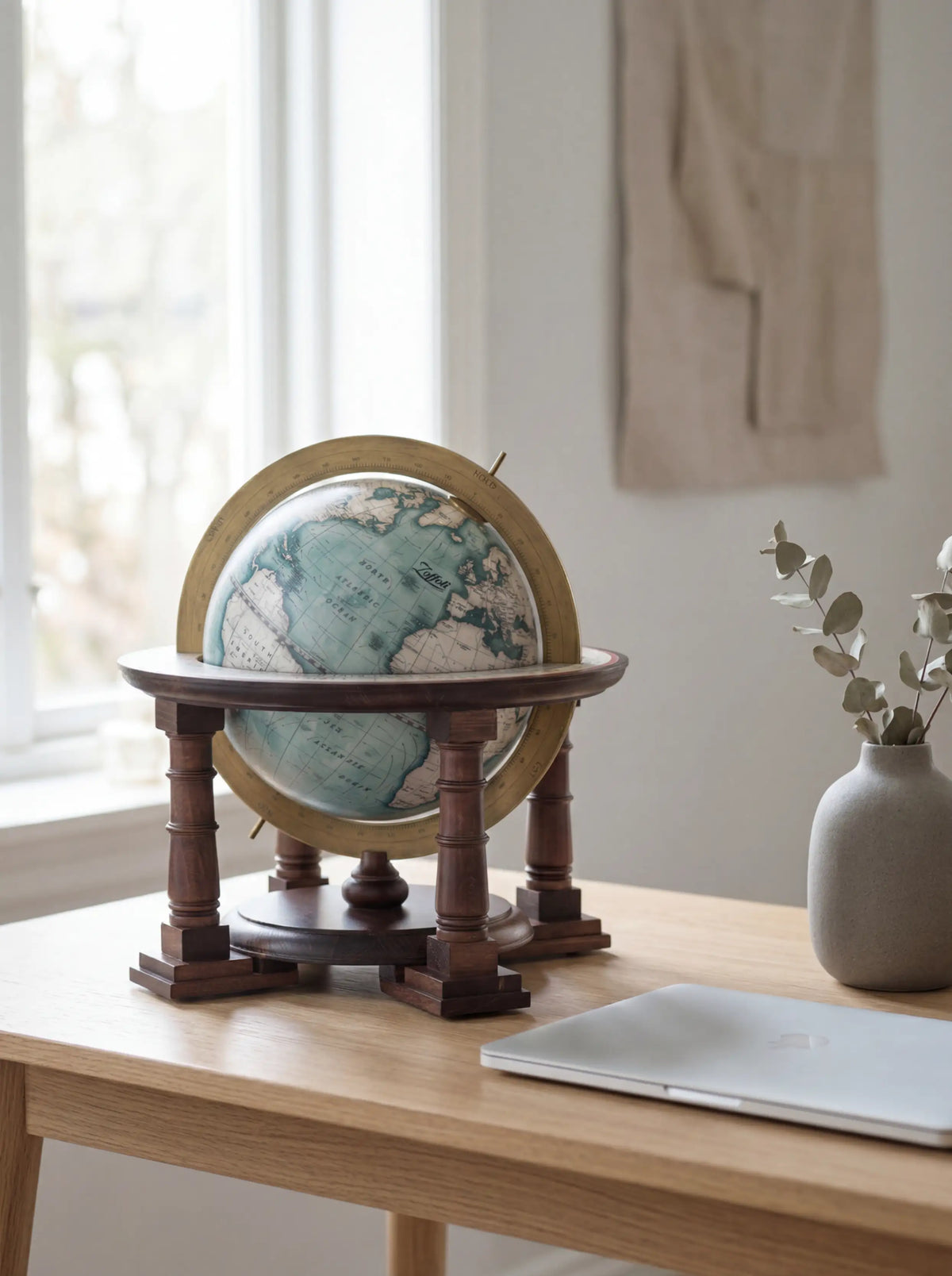
The desk cradle. A small circular or semicircular base that carries a desktop globe. It is often cast or turned metal, and its weight is what keeps the globe from tipping.

One point of confusion is worth clearing up. A metal stand does not mean a metal globe. In most cases the sphere is made of another material entirely, and the metal is only the support.
Brass: warmth that gets better with age
Brass is a copper and zinc alloy, and it is the metal most people picture when they imagine an old study. Its golden color pairs well with the ocean blues, creams and sepia tones of traditional maps. Listings for a 13-inch globe on a tall polished brass stand show how far the style stretches, from classic to decidedly contemporary.
The appeal is sensory as much as visual. Brass reflects lamplight softly, feels cool and weighty in the hand, and develops a gentle darkening over the years. That change is not damage. It is what gives a piece its lived-in quality, its calore, as we say in Italy.
There are a few things to know before you buy.
- Solid or plated. Solid brass is heavier and can be refinished. Plated finishes are lighter and can wear through at the edges where hands touch them.
- Lacquered or raw. A lacquered stand keeps its shine longer but will not develop a patina. Raw brass changes with time and needs a little more attention.
- Weight. A tripod in thin tubing may look elegant in a photo but feel wobbly in your living room. Ask for the weight whenever a listing gives it.
Cleaning brass without losing its character
There is a real difference between tarnish and patina. According to a housekeeping guide on cleaning brass, tarnish is the dull film that cleaners remove, while patina is the aged finish prized on antiques, and acidic cleaners can strip it. For a decorative globe stand, that means a soft dry cloth for regular dusting, and a gentle approach if you need more. If your stand is an antique or has a finish you love, avoid anything abrasive.
Steel, iron and powder-coated metal
Not every metal stand is brass. Black, bronze and gunmetal finishes are common on modern globes, and they give a different mood: graphic, quiet and architectural.
One reviewer-style roundup on replacement globe stands describes a Chadwick-style metal base as the standard answer when you want a clean, modern look that will not overwhelm a crowded desk. The same piece notes that metal is inherently more durable than resin or plastic. That matches what we see in practice: a metal foot survives moves, knocks and the occasional enthusiastic spin by a child.
What to check on these finishes:
- The coating. A baked or powder-coated finish resists chips better than paint. Look closely at the edges of the foot and the point where the meridian meets the base.
- The felt or rubber underneath. Metal on wood floors scratches. A good base has a protective pad. If it does not, add one.
- The color of the metal against the room. Black metal disappears on a dark floor. Brass and bronze glow against it.
Wood versus metal: how to decide
This is the question behind several of the searches people make on this topic, and the honest answer is that it depends on the room and on how you plan to use the globe.
| Consideration | Metal stand | Wood stand |
|---|---|---|
| Look | Slim, light, graphic. From polished brass to matte black | Warm, grounded, traditional |
| Durability | Strong and slender. Plated finishes can wear | Strong when solid. Veneer can chip at the edges |
| Weight | Varies widely. Quality metal feels heavy at the base | Usually substantial and stable |
| Best rooms | Modern, transitional, offices, small spaces | Libraries, studies, classic living rooms |
| Aging | Brass develops patina. Coated metal stays the same | Wood deepens in tone, and can be refinished |
| Care | Dust. Gentle cleaning for brass | Dust. Occasional wax or oil |
A third option often wins: a combination. A wooden foot gives mass and stability, while a thin metal meridian keeps the whole piece visually light. A comparison of globe materials lists wood, metal, plastic and combinations as the common stand materials, and typical diameters from 12 inches (30 cm) to 36 inches (91 cm).
Our own view: if you are choosing between the two on looks alone, think about the surrounding furniture. A walnut credenza and a brass meridian make a quiet, harmonious pair. A white-lacquered shelf and a black metal desk base do the same in a more modern way.

The globe itself: paper, plastic, cellulose
A handsome stand holds a sphere, and the sphere is what you will look at every day. The ball is made from different materials, and each one has a different feel and lifespan.
Paper gores on a board or papier-mâché core. This is the traditional method. Printed paper sections, called gores, are glued over a sphere. It gives a matte, tactile surface and a classic look. It is also the method that suits collectors, though it prefers a room without strong direct sun.
Plastic. Lightweight, inexpensive and common in educational globes and many lower-priced decorative ones. Plastic resists moisture but can feel less refined, and the seam at the equator is often visible.
Cellulose and polymer blends. A more modern approach. The Vertigo Noir floor globe from our collections uses a 24-inch (about 60 cm) cellulose-and-polymer sphere with an Italian walnut support, showing how a contemporary globe can pair modern materials with a natural wood base.
Glass, stone and ceramic. Polished stone globes are heavy and need a sturdy stand. Brass is a natural match for them, because it can carry the weight and is a visual contrast to the cool surface.
Whichever you choose, check the date of the map. Political borders change, and an older map can be a charm or a flaw depending on what you want. A decorative antique-style map is a design choice. A map meant to show the world as it is today should be recent.
What separates a quality globe from a decorative prop
You can learn a lot in about thirty seconds, even from photographs. Here is what we check on any globe, whatever it costs.
The axis and meridian
The globe should turn smoothly and stop where you leave it. If the meridian flexes, or the sphere wobbles on its pins, the stand is too light or the tolerances are loose. Pole caps that are visibly neat, with no glue marks, are a good sign.
The foot or base
The base should be heavy enough that a gentle push on the top of the globe does not move it. On a floor globe, the legs should be firmly attached, with no play. On a desk globe, a weighted foot is what prevents tipping.
The finish
Look at the places hands go: the meridian, the rim of the foot and the cap. Even finish, consistent color and neat joins show care. Painted-on gold flakes off. Properly finished metal does not.
Scale
The globe’s diameter should suit its place. The museum-focused buying guide to display stands describes the range as running from decorative pedestals and tripod bases to custom cradle mounts, which is a useful reminder that scale and support type go together. As a rule of thumb, a 12-inch globe is comfortable on a desk or side table, while larger spheres need floor space and breathing room.
Where a metal stand globe fits in your home
The most successful placements treat the globe as furniture, not an accessory.
The study or home office. A brass tripod globe beside a leather chair is a classic for a reason. It adds a point of warmth without clutter.
The living room. A floor globe with a slender metal base can stand in a corner where a lamp might go, and it takes less visual space than a wooden pedestal.
The entry or hallway. A narrow stand suits narrow spaces. Look for a base that does not extend far beyond the sphere.
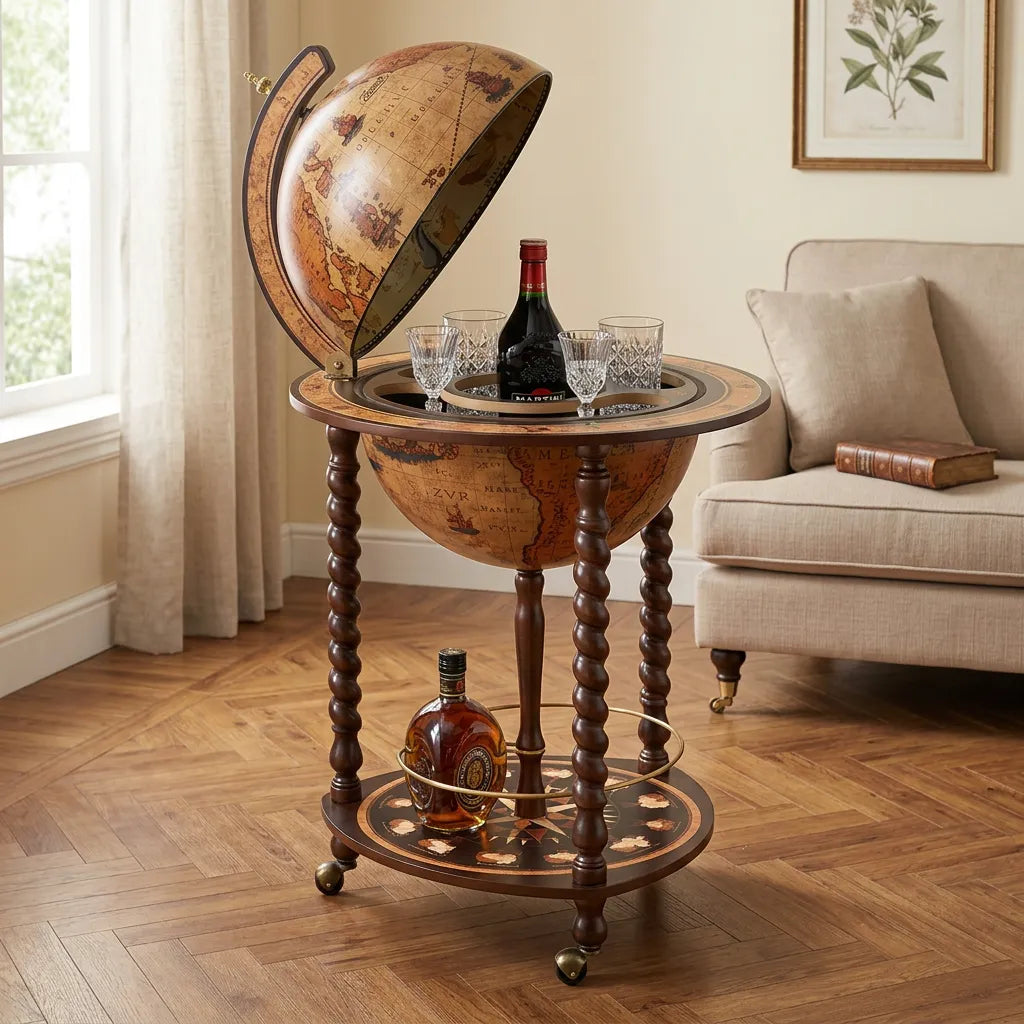
The bar or dining area. Here the globe can do two jobs. A globe bar opens to reveal a storage space for bottles and glasses, which brings us to a different kind of globe stand altogether.
When the globe is also a bar
A globe bar is a floor-standing globe whose upper hemisphere lifts to reveal an interior for spirits and glassware, supported by a stand that is built to carry the extra weight. Because the load is much greater than an ordinary globe, the base is where the engineering goes. If you are thinking about where it will live, it helps to plan it alongside your other entertaining furniture. This article on home bar cabinetry design and planning covers the broader questions of layout and storage that a globe bar naturally touches.
We make several: the Artemide floor bar globe and the Vesuvio bar globe are two you can look at to see how a bar and a stand can become one object.
A note from our workshop
We have been making globes in Italy since 1949, and in that time we have learned that the stand is where most globes quietly succeed or fail. A beautiful map on a weak base disappoints within a month. A sturdy base under a mediocre sphere feels like a missed chance.
So we start with the object as a whole. Each globe is designed and produced in Italy, with attention to materials, finishes and cartography, and we offer both classic and modern designs so that the stand and the map belong together. Our collectors often ask whether metal or wood is better. We tell them the same thing every time: choose the one that suits the room you will live with, then insist on weight, smooth movement and a finish that looks good up close.
For us, a globe should be useful and beautiful at once. That is why we also make globe bars, where the support has to be as considered as the sphere above it.
— Zoffoli
Choosing from our collections
If you would like to see these ideas in finished form, our floor globes collection shows how we pair spheres with different bases. For smaller spaces, the Gold Desk Globe is a good place to start. If you prefer a cooler, quieter palette, the Orbis in dove grey is worth a look. For a more traditional feel, our classic style globes lean toward the warm, library-like end of the range.
Prefer the whole picture? Visit the Zoffoli Living shop to browse globe bars, table globes and floor globes, or see our Gli iconici and Tele Antiche collections for the more collectible pieces.

Buying checklist
Before you commit to any globe on a metal stand, run through these questions.
- Is the stand solid metal, or plated? Ask what the finish is made of.
- Is the base heavy enough that the globe stays upright when bumped?
- Does the globe turn smoothly, without wobble or noise?
- What is the sphere made of, and does that suit your room’s light and humidity?
- How recent is the map, and is that what you want?
- Does the metal color suit your floor, shelves and other fixtures?
- If the globe is a gift, will the recipient want a decorative object or a working one?
Gifts deserve a special mention. For clients, executives or milestone occasions, a globe is a lasting alternative to the usual choices, and we have a dedicated page on corporate gifts for that purpose.
FAQ
Is a metal or a wood globe stand better?
Neither is better in every case. Metal gives a slimmer profile and tends to be more durable than plastic or resin, while wood adds visual weight and a traditional feel. Many of the best globes combine a wooden foot with a metal meridian, so you get stability and a light look together.
Can I use a brass stand with any globe?
Only if the stand was made for the globe’s size and fitting. Diameters vary widely, from around 12 inches to 36 inches, and the pole pins and meridian must match. If you are replacing a broken base, measure the globe’s diameter and the pole fitting first.
How do I clean a brass globe stand?
Dust it regularly with a soft, dry cloth. If it needs more, use a mild approach and test a hidden spot first, because acidic cleaners can strip the patina that gives aged brass its character. For an antique or valuable piece, consult a conservator before polishing.
What are globes usually made of?
Most are printed paper over a core, molded plastic, or a modern cellulose-and-polymer blend, with stands in wood, metal, plastic or a mix. Stone and glass globes exist too, and they need a heavier base. The material affects feel, weight and how the globe ages in your room.
Sources
- 6 Best Globe Stands for Replacing Broken Bases
- Globes of the World with Stand: A Journey Through Time, Space, and Style
- How to Clean Brass and Polish Without Removing Patina
- 8 Best Display Stands for Vintage Globe Collectors
- American Atelier Polished Stone Globe with Tall Brass Stand
- Vertigo Noir Floor Globe by Zoffoli