

When you think of the Zoffoli brand, the first association is, naturally, decorative globes: Bar Globes, Table and Floor Globes that have fascinated customers around the world for decades. But these are not the only luxury furnishings the company creates.
Among its crowning jewels, in fact, are the antique canvases depicting city views and planispheres, handmade and perfect for passing on tradition and the past to the present day. These are carefully crafted products, following a precise process that begins with paper design and leads to the hand-coloring of the maps.
The antique canvases that Zoffoli creates can be divided into two groups: on one hand, antique planispheres and world maps, with borders and details faithful to the era in which they were created. Among these are the Jaillot planisphere, the northern and southern celestial planispheres and the terrestrial globe, as well as Weigel's Europe and Antonio Rizzi-Zannoni's Italy.
Zoffoli also creates antique canvases with splendid views of the most famous Italian cities, such as Naples, Rome, Venice, Florence, Milan, Turin, and Perugia. An antique view of Paris is also available.
But what are all the steps in the creation of these refined canvases?

Conception and creation of the draft
The first phase of creating these elegant canvases concerns the choice of the map and its design, with a meticulous calculation of measurements, proportions, and dimensions: the design must in fact be adapted based on the canvas and the material on which it will be reproduced (in our case, pure cotton). We then proceed with the creation of a draft: every map has its own peculiarities and details, and it is in the attention to the smallest aspects that the beauty and value of what will ultimately be the produced canvas lie.
Processing and drying

When all the details are definitively planned, the practical, more distinctly manual part begins. To obtain the final product, it is first necessary to print the design in many small squares that will be assembled together at a later time.
Each sheet, made of pure cotton, is printed and engraved using a hand press and zinc plates: ink is placed on the press, while the sheet is laid over the zinc plate so that it can wrap around the press itself for printing and engraving.
This phase requires great precision and, above all, quick movements to avoid ruining the edges of the various designs. Once all the individual squares of the canvas have been printed and engraved, we proceed to the assembly phase on a large canvas, also made of pure cotton. After all the sheets have been joined, the final product must be left to dry for days so that it does not fall apart.
It is important to specify that every reproduction, even though it represents the same subject, is a unique collector's item: given the particular printing method, in fact, no two pieces are exactly alike.
Antique canvases: hand-coloring

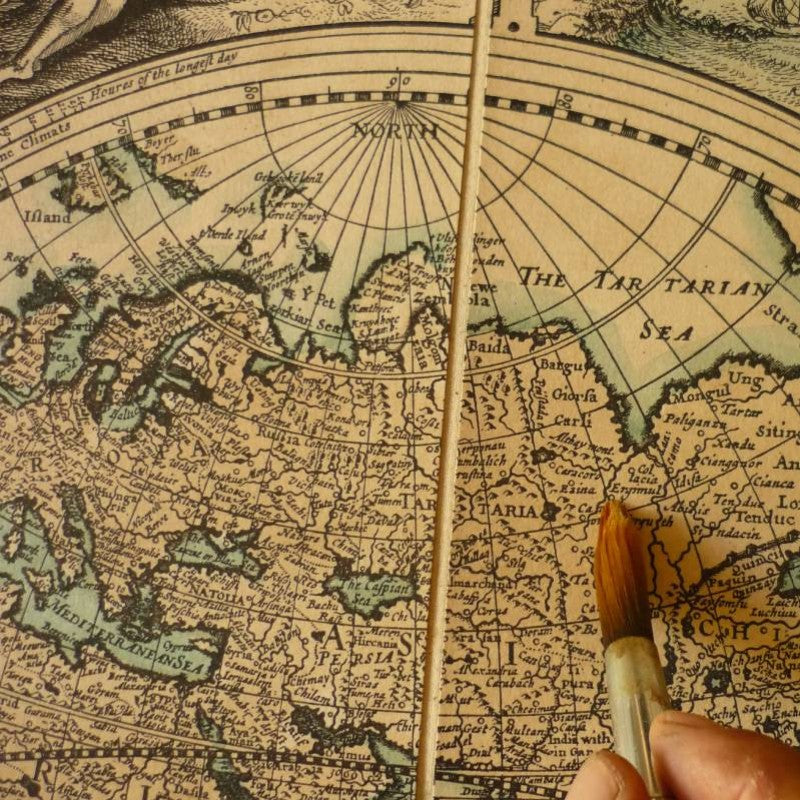
The final, very important phase is the coloring of the canvases, carried out upon customer request. This is a process performed by skilled artisans who masterfully use the watercolor technique to ensure that the print reproduces the same tones as the original drawing.
The creation of these antique canvases is a meticulous process that requires an attention to detail and craftsmanship experience that few companies still offer today. Having an antique canvas in one's home is not just a indulgence of beauty and luxury: through these prints, Zoffoli keeps the past alive and passes it on to the present day. The prints, in fact, allow us to remember our roots through a glimpse of our beloved cities or the world as our ancestors knew it. A way to keep Italian artisanal tradition and the memory of a bygone time alive, while simultaneously furnishing one's home with refined and original home accessories.


